
Harvest Time
With apologies to Samuel Beckett

I published this on Substack in November 2023 under the title “Waiting for God (…Oh!)”. I have taken out most of the stuff about Samuel Beckett’s Waiting for Godot, and given the piece a new title. The result seems particularly relevant today. You decide.
Can you feel it too? It is like humanity is holding its breath right now, as if everyone is waiting anxiously for something to happen.
Some of us are waiting for a return to pre-pandemic normality. The world was far from perfect up to a few years ago but at least we knew where we stood. People went to school, got a job, had kids, and paid their taxes. Yes, dreadful things happened but life was reasonably predictable. Why is it taking so long to get back to that?!
Others are waiting for the next big thing to hit us after a series of public threats like covid, climate change, the Ukraine war, and so on. We are being knocked from pillar to post by one calamity after another. Will it never end?
Still others are awaiting justice for the terrible crimes committed by governments against their own people, all apparently in the name of public health and safety. A co-ordinated programme of mass lockdowns, compulsory mask-wearing, vaccines, etc., devastated society and left millions around the world traumatised or even dead.
And then there are those who are simply waiting for God to come and sort everything out.
It’s not as if these categories are mutually exclusive. Many of us could probably fit into several of them. But if I had to choose one for myself it would be the last. For the past few years in particular, I have been feeling that the state of the world is so bad that only God can save us, that we are incapable of saving ourselves.
Of course, when (or if) God chooses to intervene directly in our affairs is entirely a matter for Him or Her, but many Christians believe that God can appear at any time. I am not referring to the Last Judgement described in the Gospels when, we are told, God will send the righteous to Heaven and the wicked to Hell.1 No, this belief is based on something more personal than that. An example is this story written by a friend, let’s call him André, who has given me permission to share his experience here. This is André’s story in his own words:
It was about 1986 or 1987 and I was working long hours from a room of my parents’ house in Dublin. The doorbell rang some time shortly after I had let my final client out. Nobody answered the doorbell and I was in the process of changing out of my sweaty work clothes.
Eventually, in frustration, in bare feet and flip flops I answered the door. I saw a decrepit old beggar man and immediately closed the door saying 'no thanks' or something dismissive. I entered my room which was beside the front door and immediately felt a pang of guilt at my bad behaviour.
I grabbed some money and headed outside, expecting to quickly see the old beggar man but he was gone. I shuffled as fast as I could in the flip flops to the corner and spotted him ahead of me. I continued to shuffle fast after him but I seemed to be trying to run in treacle and against a powerful head wind and I couldn't catch up.
After a while he stopped to talk to a man and I knew I was too late and that I had dismally failed what I began to realise was a spiritual test.
I miserably returned to the house absolutely believing that I had rejected God by dismissively shutting the door in His face. I had failed the test and was not entitled to or allowed to make amends by catching Him down the street.
To this day, André berates himself for having failed in what he regards as a once-in-a-lifetime test of his Christian principles. God arrived on his doorstep in an unannounced visit and, because André was not ready, he lost his chance to do the right thing, maybe forever. That is what André believes.
A scriptural basis for André’s conviction can be found in several of the Gospels. For instance, Jesus’ parable of the ten maidens differentiates between those who were ready and waiting when the bridegroom turned up unexpectedly, and the others - the ‘foolish five’ - who had gone to buy oil for their lamps and as a result missed the bridegroom’s arrival. The first group were allowed into the marriage feast; the second lot were shut out.2 As another of the Gospels put it:
You…must be ready; for the Son of man is coming at an hour you do not expect.3
André believes in God. However I am not so sure about writer, Samuel Beckett (1906-1989). He did not say much publicly about God or religion. He could have been agnostic, or atheistic, or maybe he was just a somewhat eccentric believer. The idea that the world is waiting for someone or something got me thinking about Beckett’s play, Waiting for Godot. Like me, Beckett was a Dub. Unlike me he came from an affluent background and, although we were both raised in a Christian environment, he belonged to the Protestant minority whereas I was Roman Catholic. However, as one of his biographers relates, Beckett dropped Christianity early in his life.
The last religious experience of any importance he remembers was the first Communion which followed his Confirmation. He considers the organized profession of belief “only irksome and I let it go. My mother and brother got no value from their religion when they died. At the moment of crisis it has no more depth than an old school tie.”4
The Christian emphasis on waiting and watchfulness affects people differently. Because of a momentary distraction, André believes he failed to recognise God when He suddenly appeared before him. Beckett, on the other hand, viewed the idea of waiting for God as a futile exercise and, in his play, ridiculed those who subscribed to this belief. Both perspectives, André’s and Beckett’s, stem from their absorption of Christian doctrines. And if you go back far enough those doctrines originated in the sayings and doings of Jesus Christ as recorded in the New Testament of the Bible.
Even though these doctrines came from the same source, when push came to shove, the two men responded differently. André has felt guilty for more than three decades. Beckett – at least in his most famous play - took pot-shots at religious belief and religious believers. But isn’t there a fundamental question that must be answered before we can decide if André or Beckett is correct?
Did Jesus actually say what he is reported to have said about waiting watchfully for God to appear?
This is not an irrelevant or facile point. Elsewhere I concluded that the Gospel record must have been falsified in some way in order to create a wrong impression of Jesus in the minds of subsequent generations.5 For instance I found that the account in John’s Gospel of the dying Jesus being reconciled with his mother Mary was probably false.6 I have not examined every line of the Gospels to uncover any other falsifications, so maybe that is the only one. However, according to scholarly studies conducted by numerous biblical experts, the Gospels are littered with spurious additions and mistakes. What is more, there is no authenticated source available as to what Jesus Christ said and did (or even that he really existed).
Notwithstanding these doubts, for many of us today (whether we realise it or not), Jesus’ reported words and actions offer the best insight we have into the mind of God. So is God, as implied in the Gospel passage cited above, like a ticket inspector who suddenly appears to check that we have paid our fare?7 Or is He, as Jesus is also alleged to have said, a generous benefactor who never seeks any payment for the grace he lavishes upon us all?8 If our only source about Jesus is the New Testament, and the Gospels in particular, don’t we owe it to ourselves and our children to at least try to find out which of these depictions is true, because to me they seem irreconcilable?
It is ironic to finish with something Jesus is reported to have said (and I really hope he did say it). But it gives me hope that an exercise along the lines I describe in the previous paragraph would bear fruit:
“The kingdom of heaven may be compared to a man who sowed good seed in his field; but while men were sleeping, his enemy came and sowed weeds among the wheat, and went away. So when the plants came up and bore grain, then the weeds appeared also. And the servants of the householder came and said to him, ‘Sir, did you not sow good seed in your field? How then has it weeds?’ He said to them, ‘An enemy has done this.’ The servants said to him, ‘Then do you want us to go and gather them?’ But he said, ‘No; lest in gathering the weeds you root up the wheat along with them. Let both grow together until the harvest; and at harvest time I will tell the reapers, Gather the weeds first and bind them in bundles to be burned, but gather the wheat into my barn.’”9
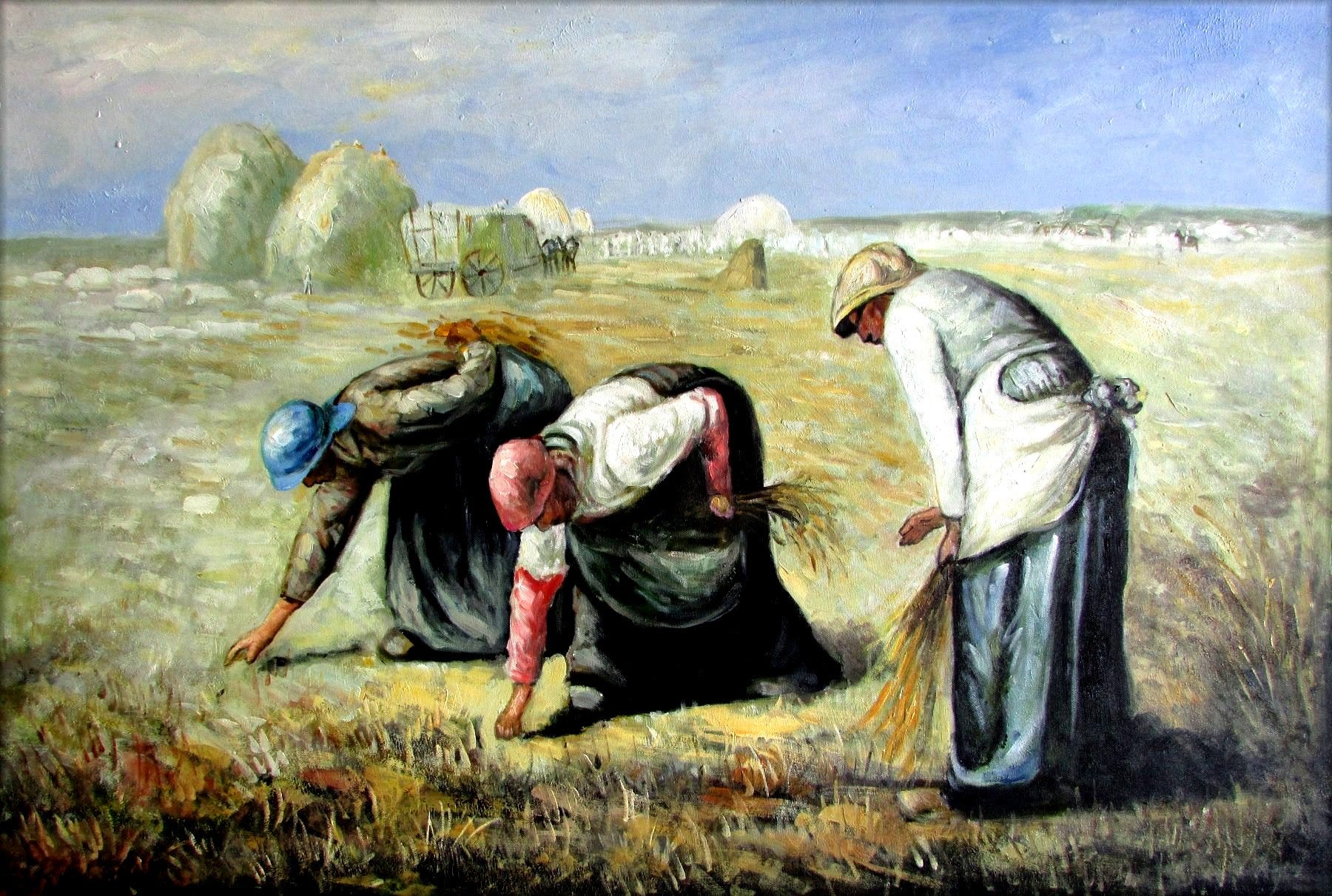
If we read this parable as applying to the separation of truth from lies, maybe “harvest time” has finally arrived?
Matthew 25:31-46.
Matthew 25:1-14.
Luke 12:40.
Deirdre Bair, Samuel Beckett: A biography (New York, 1978), p. 18.
James P. Bruce, Into the Memory Hole: Despatches from the “world of lies” (2023), p. 293.
Ibid, pp. 263-6.
Luke 12:40.
Matthew 6:25-33.
Matthew 13:24-30.