
Jesus and me (Part 5)
The enigmatic Peter

When we read about Peter in the Gospels he comes across as a kind of enthusiastic gobshite.
My late friend Brian Cleeve wrote that the Bible should be read “with intelligence and understanding, and at leisure”.1
This is exactly how I have approached my ancient and tattered copy of the Bible. As I re-read the stories of Jesus Christ’s doings and sayings I cannot say which parts are true and which are fabricated. Given that even a little research shows us that the Bible was written many centuries after the events it describes, how could anyone now spot the differences between truth and fiction? So God, Jesus Christ, etc., etc., might be part of a gigantic hoax perpetrated on humanity by nefarious monks writing in the Middle Ages!
That is more or less the conclusion reached by many eminent people. They believe it is all bollocks - all of it. I have written about some of them (sympathetically I hope).2 However I do not agree with their position on these questions. I hope that is clear also.
Sometimes I wonder why anyone else would think like I do. Maybe some share my conviction that God and Jesus are real. Others might be guided by a more tentative feeling, an instinct perhaps, that I could be on to something. Or are they simply curious, following this thread without any commitment to the dénouement (if I ever reach it!)?
Whatever, in this instalment I want to dwell on something Damian wrote in the article ‘Upon This Rock’, which I quoted at length in Part 4.
In fact, in the Gospels as a whole no other disciple (including Judas) comes in for as much criticism as Peter. This exchange between Jesus and him is a perfect example. Not only is Peter referred to as Satan but Jesus also calls him a hindrance, or in the Greek a ‘stumbling block’.
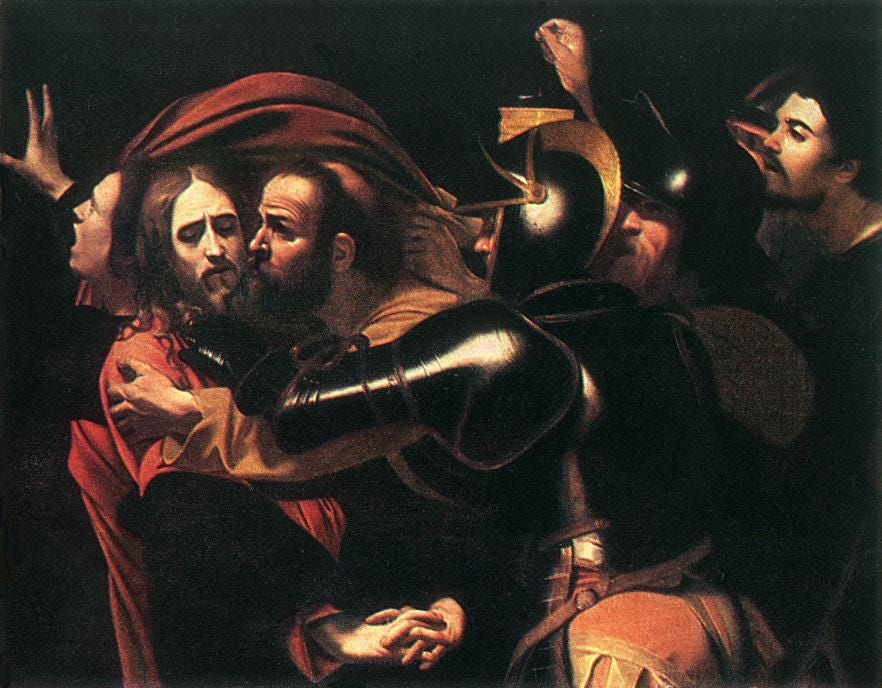
The allusion to Judas is perfectly true. According to the Gospel accounts, Christ never excoriated him as he did Peter. Whenever he is mentioned, Judas is often referred to as the disciple who betrayed Jesus. The following Gospel passage is typical.
Then Satan entered into Judas called Iscariot, who was of the number of the twelve; he went away and conferred with the chief priests and captains how he might betray him to them.3
This extract highlights an important distinction between Judas and Peter. When Christ delivered his extraordinary rebuke to the man he had so recently appointed first ‘pope’, he did not say that Satan had “entered into” Peter. That turn of phrase implies a temporary state of affairs that could potentially be reversed. No, Jesus accused Peter of being Satan, i.e. the ‘ruler of this world’. As I described elsewhere, Satan effectively dogged Christ’s footsteps throughout his public life.4
When we read about Peter in the Gospels he comes across as a kind of enthusiastic gobshite. Or as one of Peter’s modern biographers put it:
Peter is so human, so like ourselves in his downsittings and uprisings, so compassed with infirmity…5
We can all identify with this Peter, can’t we? We reckon that, if Christ could appoint someone so feeble to head up his new religion, there is hope for us all. Peter is presented in the Bible as a model that even the weakest of us can follow.
That would be the end of the story - but for one inconvenient detail. If only whoever wrote Matthew’s Gospel had left out the bit about Peter being Satan, especially when it comes just after Jesus’ naming of the same man as head of his new religion, we could more easily accept the conventional image of Peter the well-intentioned buffoon.6
However last time I referred to Peter as “enigmatic”. He was certainly that, and maybe more. But for now I will confine myself to this. I believe the two passages in Matthew’s Gospel are irreconcilable.7 One or the other must be false. To believe anything else would be to descend into the ridiculous.
But let us go down that particular ‘rabbit hole’ and look at two alternative explanations that might bridge the gap
Maybe Jesus did not literally mean to equate Peter and Satan, or refer to him as a “hindrance”. When Christ reportedly spoke in such stark terms perhaps he was being figurative only.
Another possibility is that Jesus forgot to withdraw his nomination of Peter as soon as he realised he was handing his church over to ‘the ruler of this world’ or Satan himself.
If we were to swallow either of these scenarios whole, we would have to accept also that Christ was something of a gobshite himself. And whatever he was, Jesus was never that!8
This leads me to an inescapable conclusion: Christ’s appointment of Peter as first pope never happened. It is bogus, a fabrication. More than likely those lines were inserted by the Gospel author, or by a later editor, in order to legitimise the setting up of Christianity.
So if neither Peter nor Jesus Christ himself founded the Christian religion, is there anyone else about whom a better case can be made?
More in Part 6
Brian Cleeve, The Seven Mansions (London 1980), p. 117.
Examples are Jean-Paul Sartre and Pyotr Tchaikovsky. See Into the Memory Hole: Despatches from the “world of lies” (2023), pp. 199-201.
Luke 22:3-4.
Into the Memory Hole, pp. 143-5.
F. B. Meyer, Peter: Fisherman, Disciple, Apostle (New York 1920), p. v.
Brian Cleeve believed that, while the Gospels were produced by fallible writers, they were also guided by God so that essential truths would be preserved, however obliquely. Is the juxtaposition of those contradictory passages about Peter an example of this divine intervention?
Matthew, 16:17-19 & 16:21-23.
Even though he is recorded as having used metaphorical language from time to time, Christ was always direct when it came to his longstanding foe, Satan.
I think I'm going to die wondering JP, because I can't put my faith in anyone now. I sometimes don't even know if Jesus existed. Is he the one you refer to as Christ. Does Christ mean God. Who is God. A friend of mine wrote a book, it's in PDF format, I haven't read it, I'm too all over the place. He says Yaweh is the God of the old Testament. I think I heard somewhere along the way that the powers during some century put the new book on top of the old and called it the Holy Bible. Certainly you couldn't believe anything King James would put his name too. All bloodline tyrants. 2020 did me some serious damage to the extent I don't believe much even anything the alt media puts out. I think the alt media were put in place long ago. Same old people interviewing each other. I'm just going to live the rest of my life enjoying every moment outside I can and telling everyone I meet something small to perk their curiousity. I usually make a mess of it! I just call God my creator